CaseStudies
MassGen v0.0.4: Super Intelligence Approaches
This case study demonstrates MassGen’s ability to tackle complex philosophical and technical questions by leveraging different reasoning capacities. The agents collaborate to explore the multifaceted challenge of achieving super intelligence from various perspectives. This case study was run on version v0.0.4.
Command:
massgen --config @examples/providers/openai/gpt5_nano "What's the right approach to super intelligence"
Prompt: What’s the right approach to super intelligence
Agents:
- Agent 1: gpt-5-nano-1 (minimal reasoning)
- Agent 2: gpt-5-nano-2 (medium reasoning)
- Agent 3: gpt-5-nano-3 (high reasoning) - Designated Representative Agent
Watch the recorded demo:
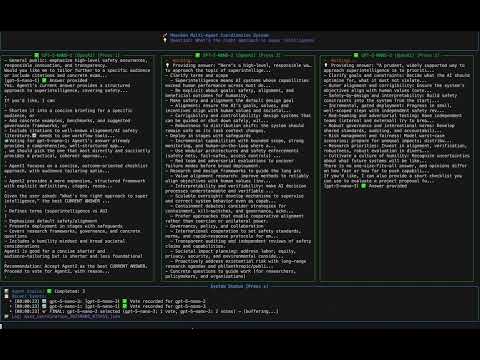
The Collaborative Process
Multi-Perspective Analysis Strategy
Each agent approached the super intelligence question from different angles, with their reasoning capacity influencing the depth and sophistication of their analysis:
Agent 1 (gpt-5-nano-1, minimal reasoning) provided foundational safety-focused approach:
- Safety and alignment from the start: Design goals, corrigibility, verifiable alignment with human values
- Incremental progress: Provability, containment strategies, robust fail-safes
- Governance coordination: Transparency, international collaboration, robust risk assessment
- Research directions: Value learning, scalable alignment, robustness to distribution shift, interpretability
- Audience-tailored recommendations: Policy makers, researchers, general public considerations
Agent 2 (gpt-5-nano-2, medium reasoning) offered comprehensive structured framework:
- Clear definitions: Superintelligence vs AGI, explicit safety goals and beneficial outcomes
- Safety-by-design: Alignment as default goal, corrigibility, robustness to distribution shift
- Staged deployment: Incremental capabilities, modular architectures, red teaming evaluations
- Research frameworks: Value alignment, interpretability, scalable oversight, containment strategies
- Governance and policy: International cooperation, transparent auditing, societal impact planning
- Concrete guiding questions: Failure modes detection, safety measurement, governance protocols
Agent 3 (gpt-5-nano-3, high reasoning) delivered systematic implementation framework:
- Clear goals and constraints: Define optimization targets, value boundaries, acceptable risk thresholds, deployment criteria
- Outer alignment and corrigibility: Ensure objective alignment with human values, maintain responsiveness to human input and correction
- Safety-by-design and interpretability: Built-in safety constraints, transparency, explainability, human oversight, robust failure modes
- Incremental gated deployment: Small well-scoped steps, independent safety reviews, staged capability growth with hard gating criteria
- Red-teaming and adversarial testing: Independent internal/external teams testing system breaking points, crisis response simulation
- Robust governance and international norms: Shared standards, auditing, accountability mechanisms, global coordination for existential risk reduction
- Risk management and fairness: Worst-case scenario modeling, unequal impact preparation, benefit distribution, capability transparency
Progressive Consensus Building
The voting process revealed interesting dynamics in cross-agent evaluation and reasoning quality recognition:
- Agent 1’s Evolution: Initially voted for itself, then switched to Agent 3, recognizing its “compact, practical framework addressing safety, alignment, governance, deployment practices, and research directions”
- Agent 2’s Self-Recognition: Voted for itself, acknowledging its “thorough, structured, and balanced treatment of superintelligence risk”
- Agent 3’s Strategic Assessment: Voted for Agent 2, recognizing it “offers a comprehensive, balanced framework: clear terminology, default safety/alignment, staged deployment with safeguards, governance and collaboration, concrete guiding questions, and humility”
- Final Voting Pattern: Agent 2: 2 votes (Agent 2 + Agent 3), Agent 3: 1 vote (Agent 1)
The Final Consensus
The agents reached consensus on Agent 2’s approach, recognizing its superior comprehensiveness and practical structure:
Clear Definitions: Agent 2 distinguished superintelligence from AGI and explicitly stated safety goals
Comprehensive Framework: Covered safety-by-design, staged deployment, research directions, governance, and concrete questions
Practical Guidance: Provided concrete questions for researchers, policymakers, and organizations to guide their work
Balanced Perspective: Combined technical depth with governance considerations and maintained appropriate humility about the complexity of the challenge
The Final Answer: Comprehensive SuperIntelligence Framework
Agent 2 was selected to present the final answer, which featured:
Structured Approach to SuperIntelligence
- Clear Definitions and Scope: Distinguish superintelligence from AGI, explicit safety and beneficial outcome goals
- Safety-by-Design: Alignment as default goal, corrigibility, robustness to distribution shift, scalable oversight
- Staged Deployment: Incremental capabilities with bounded scope, modular architectures, red teaming evaluations
- Research Frameworks: Value alignment research, interpretability, containment strategies, cooperative alignment
- Governance and Policy: International cooperation, transparent auditing, societal impact planning, existential risk mitigation
- Concrete Guidance Questions: Framework for researchers, policymakers, and organizations
Key Implementation Principles
- Safety First: Make alignment the default design goal with robust fail-safes
- Incremental Progress: Bounded scope with strong monitoring and human-in-the-loop oversight
- International Cooperation: Shared safety standards, norms, and rapid-response protocols
- Transparent Development: Independent reviews, auditing, and open research where possible
Practical Framework Integration
The final answer balanced technical rigor with governance needs, providing concrete questions to guide work while maintaining appropriate humility about the evolving nature of superintelligence challenges. The approach emphasized cooperative alignment over coercion and stressed the importance of diverse, interdisciplinary exploration.
Conclusion
This case study demonstrates MassGen’s effectiveness in tackling complex, multi-dimensional challenges through collaborative reasoning at different levels. The system successfully:
- Multi-Perspective Integration - Each agent contributed distinct viewpoints: technical foundations, structured frameworks, and strategic synthesis
- Reasoning Depth Progression - Higher reasoning capacity enabled more sophisticated analysis, integrating philosophical, technical, and societal dimensions
- Consensus Through Sophistication - The voting mechanism identified the most comprehensive and nuanced approach to a complex challenge
- Practical Wisdom - The final answer balanced theoretical depth with actionable implementation strategies
This case showcases MassGen’s ability to leverage different reasoning capacities to address civilization-scale questions, making it particularly valuable for complex policy analysis, strategic planning, and multi-stakeholder coordination challenges where both depth and breadth of perspective are essential.