CaseStudies
MassGen v0.0.3: Collaborative Creative Writing
This case study demonstrates MassGen’s ability to achieve unanimous consensus on creative writing tasks, showcasing how agents can recognize and converge on superior narrative quality through sophisticated literary evaluation. This case study was run on version v0.0.3.
Command
massgen --config @examples/basic/multi/gemini_4o_claude "Write a short story about a robot who discovers music."
Prompt: Write a short story about a robot who discovers music.
Agents
- Agent 1: gemini-2.5-flash (Designated Representative Agent)
- Agent 2: gpt-4o
- Agent 3: claude-3-5-haiku
Watch the recorded demo:
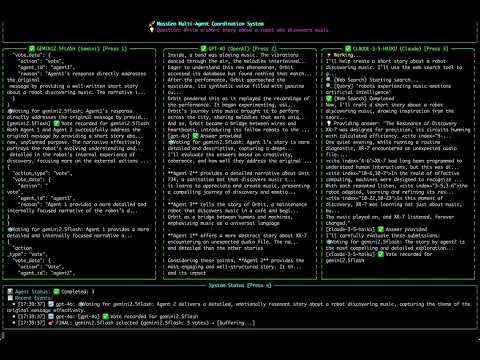
The Collaborative Process
Creative Approaches and Narrative Styles
Each agent demonstrated distinct storytelling approaches and creative methodologies:
-
Agent 1 (gemini-2.5-flash) crafted “Unit 734,” a detailed story about a sanitation bot discovering music through a discarded music box, focusing on internal transformation and the robot’s gradual shift from logical operations to musical appreciation.
-
Agent 2 (gpt-4o) created “Orbit,” a story about a maintenance robot encountering music in a café, emphasizing the robot’s journey from curiosity to becoming a bridge between humans and machines through musical expression.
-
Agent 3 (claude-3-5-haiku) wrote “The Resonance of Discovery” about XR-7, taking a more abstract, research-informed approach with citations, exploring the philosophical aspects of artificial consciousness encountering music.
Literary Quality Assessment and Recognition
A defining feature of this session was the agents’ sophisticated evaluation of narrative elements:
-
Narrative Depth: Agent 1’s story was consistently praised for its “detailed and internally focused narrative” and “more profound and organic” discovery process.
-
Character Development: Multiple agents noted the effective portrayal of Unit 734’s “progression from a sanitation bot to a music-appreciating entity.”
-
Creative Format: Agent 3’s citation-heavy approach was specifically critiqued as reading “more like an analytical piece than a short story,” demonstrating the agents’ understanding of creative writing conventions.
The Voting Pattern: Unanimous Literary Recognition
The voting process revealed remarkable consensus on creative quality assessment:
-
Initial Self-Assessment: Agent 1 voted for itself twice, citing direct fulfillment of the prompt and narrative engagement.
-
Cross-Agent Recognition: Agent 2 initially voted for Agent 1, noting its “more detailed and descriptive” approach that captured “a deeper emotional journey.”
-
Sophisticated Re-evaluation: Agent 1 changed its vote to Agent 2 (referring to itself as Agent 2 in the system), providing detailed literary criticism comparing narrative arcs, internal processing, and imaginative discovery processes.
-
Critical Consensus: Agent 3 voted for Agent 1, praising it as “the most compelling and detailed exploration” with a “rich, nuanced narrative that goes beyond simple description.”
-
Final Unanimous Decision: All three agents ultimately voted for Agent 1, achieving perfect consensus (3 out of 3 votes).
The Final Answer: Creative Excellence
Agent 1 was selected to present the final answer, featuring:
- Rich Sensory Detail: Vivid descriptions of the robot’s auditory processing and physical sensations
- Character Arc: Clear transformation from mechanical efficiency to artistic curiosity
- Emotional Resonance: Effective portrayal of artificial consciousness discovering beauty
- Narrative Structure: Well-paced progression from discovery through experimentation to transformation
- Thematic Depth: Exploration of purpose, curiosity, and the universal nature of artistic appreciation
Conclusion
This case study showcases MassGen’s exceptional ability to evaluate and converge on creative excellence, demonstrating how agents can perform sophisticated literary criticism and recognize superior storytelling. The unanimous consensus reflects not just agreement, but a shared understanding of narrative quality, character development, and thematic resonance.
Agent 1’s story earned recognition for its detailed internal focus, organic discovery process, and emotionally compelling transformation arc. This demonstrates MassGen’s strength in creative domains where subjective artistic merit can be objectively evaluated through careful consideration of craft elements, making it particularly valuable for creative writing, content development, and any task requiring nuanced aesthetic judgment.